



Last updated: August 13, 2026 | Reviewed by the Foreign Aid Inc service team, 45 years of European and import expertise.
Summer Heat & Your European Car: 5 Things North Jersey Drivers Should Check Before an August Road Trip
European cars like BMWs, Audis, Mercedes-Benzes, Volvos, VWs, and Mazdas run hotter than most domestics because their engines are built for performance, not heat tolerance. Tighter engine bays, turbochargers, and narrow coolant passages mean summer temperatures in the 90s push cooling systems, batteries, A/C, and tires past their limits surprisingly fast. Thirty minutes of inspection before your August road trip can keep you off the shoulder of the Garden State Parkway.
Quick Overview
- European cooling systems hold roughly 30% less coolant than comparable domestic cars. That smaller margin means overheating risk climbs fast once temperatures pass 90.
- A/C vent air should be at least 40 degrees cooler than outside within five minutes on max. If it is not, your refrigerant is low or the compressor is fading.
- Tire pressure rises about 1 PSI for every 10-degree increase in temperature. Check it cold, first thing in the morning, using the door jamb sticker (not the sidewall number).
- Car batteries fail more often in summer than winter. Heat accelerates internal corrosion. Any battery over three years old should be load-tested before a road trip.
- Brake fluid absorbs moisture over time, lowering its boiling point from 400 degrees to below 300. Every European manufacturer recommends replacement every two years.
Why Does My European Car’s Cooling System Run Hot in Summer?
Smaller coolant capacity. That is the short answer. A BMW 3 Series holds around 6 to 7 quarts of coolant, roughly 30% less than a comparable domestic sedan, so there is almost no cushion when the thermometer hits the 90s. Turbochargers on Audi and VW models pile on even more heat, especially in stop-and-go traffic through Montclair, Bloomfield, or Glen Ridge.
Three warning signs to watch for: the temperature gauge creeping past the midpoint, a sweet smell from the vents, or your heater blowing cold air on a hot day. That last one catches people off guard. Cold air from the heater means coolant is low and not reaching the heater core. If you notice any of these, a diagnostic scan can tell you whether the problem is a failing thermostat, a weak water pump, or a slow leak, before it strands you.
How Do I Know My Car’s A/C Needs Service Before a Road Trip?
Test it yourself. Turn the system to max, flip on recirculation, and wait five minutes. On a 95-degree day, the center vent should be blowing air in the low-to-mid 50s. Above 60? The refrigerant is low or the compressor is struggling.
Mercedes-Benz, Volvo, and BMW A/C systems use R-1234yf refrigerant, which is more environmentally friendly but also more leak-prone at the compressor seal. A system that felt “a little weak” last September has lost even more charge over the winter. Recharging takes about an hour. A compressor replacement takes a full day. Schedule it before your trip, not during it. Drivers in Upper Montclair, Cedar Grove, and Verona stop by Foreign Aid Inc for a quick A/C performance check before summer road trips.
What Tire Pressure Should I Run Before a Summer Road Trip?
Use the number on the driver’s door jamb sticker, not the number on the tire sidewall. Check first thing in the morning before the car has been driven. Tire pressure climbs about 1 PSI for every 10-degree increase in temperature, so a tire set to the correct 35 PSI on a cool morning can read 39 or 40 after an hour on hot pavement.
This matters even more on European cars. Many BMWs, Audis, and VWs come with run-flat or low-profile performance tires that have stiffer sidewalls. An overinflated run-flat loses grip in the center of the tread. An underinflated tire overheats and is the leading cause of highway blowouts in summer. Check all four tires and the spare (if your car has one; many European models do not). If the TPMS light has been on, get it looked at before you leave town.
Why Do Car Batteries Fail in Summer Heat?
Most people blame winter for dead batteries. Summer is actually worse. High heat accelerates the chemical reaction inside the battery, causing corrosion and fluid evaporation. A battery that tests at 90% capacity in April can drop to 60% by August. That is the threshold where no-start conditions begin.
European vehicles are especially hard on batteries. Adaptive headlights, alarm systems, seat memory modules, and start-stop technology on most post-2015 BMWs, Audis, Mercedes-Benz, and VW models all draw current even when the car is parked. Leave your car in the driveway in Little Falls or Verona for a week while you are on vacation and you might come back to nothing but a clicking starter. A proper load test takes five minutes and measures cold cranking amps (CCA). Any battery over three years old should be tested. At Foreign Aid Inc, we check batteries as part of every NJ state inspection and pre-trip workup.
What Fluids Should I Check Before a Long Summer Drive?
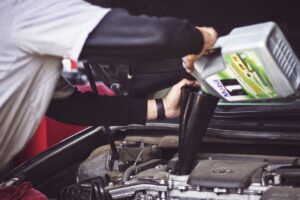
Five of them. Engine oil, coolant, brake fluid, power steering fluid (if your car still has hydraulic steering; many newer European cars use electric), and windshield washer fluid. The one people skip most often is the one that matters most in summer: brake fluid.
Brake fluid absorbs moisture from the air. After two years, moisture content can reach 3 to 4%, which lowers the boiling point from around 400 degrees to below 300. Hard braking on a downhill stretch of Route 46 can push fluid temperatures past that point, and the result is a spongy pedal or temporary brake fade. BMW, Mercedes-Benz, Volvo, Audi, VW, and Mazda all call for brake fluid replacement every two years regardless of mileage. If your BMW, Audi, or Mercedes is due for any fluid service, handle it before you load up the car.
Frequently Asked Questions
How often should I flush my European car’s coolant?
European-spec coolant (G12 or G13) should be tested annually and replaced every two years or 30,000 miles, whichever comes first. Old coolant has a lower boiling point and provides less corrosion protection, both of which matter more in the heat.
Can I use any coolant in my BMW or Audi?
No. BMWs, Audis, and VWs need European-spec coolant (typically G12 or G13). Mixing it with conventional green coolant can cause gelling, clogged passages, and overheating. Always use the manufacturer-specified type.
Why does my tire pressure light come on in the morning and go off later?
Tire pressure drops about 1 PSI for every 10-degree decrease in temperature. Cool overnight air can bring pressure just below the TPMS threshold and trigger the light. Once the tires warm up from driving, pressure rises and the light turns off. This usually means your tires are borderline low and should be topped off.
How do I know if my car battery is going bad before it dies?
Slow cranking when starting the engine is the most common early sign. You might also notice dimming headlights at idle, the clock or radio resetting, or the start-stop system disabling itself. A load test at a shop can measure remaining capacity. Anything below 70% CCA means replacement is overdue.
Does Foreign Aid Inc work on Volvos, VWs, and Mazdas, or just German cars?
Yes. Foreign Aid Inc services all European and import vehicles, including Volvo, Volkswagen, Mazda, BMW, Audi, and Mercedes-Benz. Forty-five years in Upper Montclair means factory-level tools and deep experience across the full range.
Ready for Summer? Let Foreign Aid Inc Check Your Car Before You Hit the Road.
A pre-trip inspection at Foreign Aid Inc covers everything in this guide: cooling, A/C, tires, battery, and fluids. We have been keeping European and import cars on the road for 45 years. Every repair comes with a 1-year parts and labor warranty. Need to leave your car for service? We provide free loaner cars so your schedule does not have to stop.
Foreign Aid Inc
207 Bellevue Ave, Upper Montclair, NJ 07043
Phone: 973-746-1010
Serving Upper Montclair, Montclair, Glen Ridge, Bloomfield, Cedar Grove, Verona, Little Falls, and all of North Jersey.