
Last updated: August 21, 2026 | Reviewed by the Foreign Aid Inc service team, 45 years of European and import expertise.
If your brakes squeal, grind, vibrate, or feel soft when you press the pedal, your car needs brake service soon. Squealing usually means the wear indicator is touching the rotor. Grinding means metal is hitting metal and damage is already happening. A spongy or pulsating pedal points to a fluid issue or warped rotors. Any of these signs means it is time to get the brakes inspected before a small repair becomes a big one.
Quick Overview: European Car Brake Warning Signs
Recognizing early brake warning signs on your BMW, Audi, or Mercedes lets you schedule professional brake service before minor wear turns into expensive repairs.
A high-pitched squeal means your wear indicator tab or electronic sensor has been triggered with pads down to 2 to 3 millimeters, while harsh grinding indicates complete pad depletion and active rotor damage.
A soft or spongy brake pedal points to air in the lines or a fluid leak, whereas pedal vibration during North Jersey stop-and-go driving usually stems from warped rotors. If your vehicle pulls to one side, a stuck caliper or hydraulic hose issue is likely at fault.
Catching these signs early for a pad replacement or brake fluid flush protects your rotors, prevents costly caliper failure, and keeps your European car stopping safely.
Why Does My BMW Squeal When I Brake?
That squeal is almost always the wear indicator doing its job. European brake pads have a small metal tab near the bottom of the pad material. When the pad wears down to about 2 to 3 millimeters, that tab starts dragging against the rotor. The noise is intentional. It is an alarm.
On BMW models, many cars also use electronic wear sensors that trigger a dashboard warning before the audible squeal starts. Yellow brake pad icon on your dash? Do not wait for noise. The computer already knows.
Light squeaking after rain or overnight sitting is different. Moisture causes thin surface rust on rotors, and the first few stops scrub it off. If the squeal is consistent and louder over days, the pads need replacing. Drivers in Upper Montclair, Montclair, and Glen Ridge catch this early because stop-and-go on Bloomfield Avenue wears pads faster than highway cruising.
How Long Do European Car Brake Pads Last?
Most pads on BMW, Audi, Mercedes-Benz, Volvo, VW, and Mazda last between 30,000 and 70,000 miles. That range depends on driving habits and terrain.
City driving kills pads. A BMW X3 driven through Bloomfield and Cedar Grove might need pads at 30,000 miles. The same X3 on the highway gets 55,000 or more. Riding the brakes downhill generates heat that accelerates wear and can warp rotors.
European compounds are softer than domestic pads. Better stopping feel, shorter distances, but faster wear and more brake dust. Audi and BMW owners know the wheel-cleaning routine. Front pads handle 60% to 70% of braking force, so they wear first. We regularly see cars where the fronts are finished and the rears still have half their life.
Is It Safe to Drive With Grinding Brakes?
No. Grinding means the pad material is gone and metal is pressing directly against the rotor. Every mile carves grooves into the rotor. A $400 pad replacement turns into $900 to $1,200 because now the rotors need replacing too.
If the pad disintegrates entirely, the caliper piston can overextend and damage the caliper. That pushes the repair past $1,500. This is not a “drive it until payday” situation.
Foreign Aid Inc keeps common brake parts for BMW, Audi, Mercedes, Volvo, VW, and Mazda in stock. Most brake jobs finish the same day. We provide free loaner cars if the repair runs longer.
What Does a Soft or Vibrating Brake Pedal Mean?
Two different problems. Both need attention.
Soft or spongy pedal. Most common cause: air in the brake lines. Air compresses. Brake fluid does not. When air enters the system, pedal pressure gets absorbed instead of reaching the calipers. A flush and bleed runs $150 to $250 on European vehicles. A soft pedal can also mean a failing master cylinder or fluid leak. If the pedal sinks to the floor, get it checked immediately.
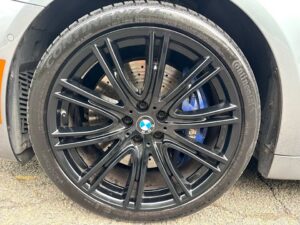
Vibrating pedal or steering wheel. Pulsation during braking almost always means warped rotors. Rotors warp from overheating: aggressive stops, riding the brakes on hills, or holding the brake at a light after a hard stop (the pad bakes a hot spot into the rotor). Mercedes-Benz and BMW models with larger wheels are especially prone.
Brake fluid needs attention too. Most manufacturers recommend flushing it every two years regardless of mileage. Brake fluid absorbs moisture over time, lowering its boiling point. The U.S. Department of Energy’s vehicle maintenance guide reinforces that staying on top of manufacturer service intervals protects both safety and vehicle longevity.
How Much Does Brake Service Cost for a BMW, Audi, or Mercedes?
It depends on what needs replacing and whether you caught it early.
Pad replacement only (both axles): $350 to $600 for most European models. Best case: you responded to the squeal before rotor damage started.
Pads and rotors (one axle): $500 to $900. European rotors are thinner by design and usually cannot be resurfaced. Once scored or below minimum thickness, replacement is the only option.
Full brake system service (pads, rotors, fluid flush, caliper inspection, both axles): $1,000 to $1,800 depending on the vehicle.
Dealership prices run 30% to 50% higher. Foreign Aid Inc backs every brake job with a 1-year parts and labor warranty and uses OE-quality or genuine parts. Cheap pads create more dust, wear faster, and sometimes squeal right out of the box.
When Should I Get My Brakes Inspected?
Do not wait for a warning sign. Get a visual brake inspection at every tire rotation or oil change, roughly every 7,500 to 10,000 miles. If something changed about how your brakes sound, feel, or perform, get it looked at. Something new appeared. Investigate it.
Drivers in Verona, Little Falls, and across North Jersey who stay on top of inspections spend less over the life of the car. Catching pads at 3mm saves the rotors. Catching rotors early saves the calipers. Foreign Aid Inc’s NJ state inspection includes a brake check, and our full vehicle diagnostics catch brake sensor faults before they produce noise.
Frequently Asked Questions
Why do European car brakes produce so much dust?
European pads use a softer compound for shorter stopping distances and better pedal feel. The tradeoff is more brake dust. This is common on BMW, Audi, and Mercedes vehicles. Low-dust aftermarket pads exist but may sacrifice some stopping performance.
How often should brake fluid be flushed on a BMW, Audi, or Mercedes?
Every two years, regardless of mileage. Brake fluid absorbs moisture over time, lowering its boiling point. Most European manufacturers specify a two-year interval.
Can I replace just the brake pads without replacing the rotors?
Yes, if the rotors are within spec. A technician measures thickness and checks for scoring or warping. Smooth surface and above minimum thickness means new pads alone are fine. Scored or thin rotors need replacing at the same time, or you will get uneven wear and noise almost immediately.
Is it normal for new brakes to squeal?
Light noise during the first 100 to 200 miles is normal. The pad surface needs to mate with the rotor, a process called bedding in. If the squeal continues past that, the pads may be defective or the wrong compound for the vehicle.
Does Foreign Aid Inc offer a warranty on brake repairs?
Yes. Every brake repair comes with a 1-year parts and labor warranty. We provide free loaner cars if the repair takes more than a few hours. Call 973-746-1010 or stop by 207 Bellevue Ave in Upper Montclair.
Stop the Problem Before It Stops You
Brakes are the one system where “wait and see” always costs more. Every squeal becomes a grind. Every grind becomes a rotor. Every rotor becomes a caliper. The math only goes one direction.
Foreign Aid Inc has been keeping European and import vehicles safe on North Jersey roads for 45 years, with 108+ reviews at 4.7 stars. Whether you drive a BMW, Audi, Mercedes, Volvo, VW, or Mazda, we have seen your brake system before. Probably hundreds of times.
Foreign Aid Inc
207 Bellevue Ave, Upper Montclair, NJ 07043
Phone: 973-746-1010
Serving Upper Montclair, Montclair, Glen Ridge, Bloomfield, Cedar Grove, Verona, Little Falls, and all of North Jersey.